
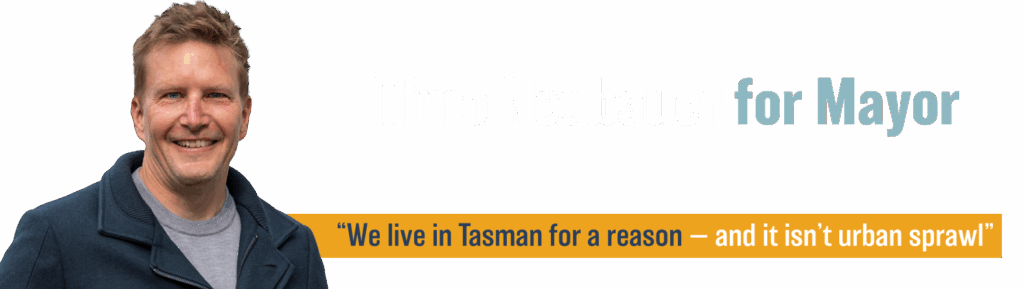
Throughout my campaign, one of the most persistent criticisms I’ve heard about my proposed housing strategy is a personal one – that I “want to shove everyone else into high-density housing while I enjoy my beautiful lifestyle property,” suggesting a “do as I say and not as I do” attitude.
So let’s set the record straight.
When my family and I first came to Tasman, we were actually looking for a centrally located property in Richmond where we could build and run our business. However, TDC’s planners rejected that idea and directed us toward a rural block instead. That’s where we’ve ended up – producing fruit for the domestic market, raising stock, and running an agri-tourism venture that employs locals. It’s not at all what we originally planned, and it’s certainly not your typical “lifestyle block.”
In my earlier years, a rural lifestyle wouldn’t have appealed to me at all. I preferred to be close to the action and spent much of my life living in apartments and townhouses – homes that were affordable, low-maintenance, and close to work and community life. And when I’m older, I’ll probably look for something similar again. The problem is, in Tasman, those options simply don’t exist. My housing plan isn’t about me – it’s about the many people who want and need different options and who cannot afford the escalating rates that inevitably follow our current sprawling approach to development.
My call for more compact, well-designed intensification isn’t about forcing anyone into a particular lifestyle. It’s about restoring choice to a market that’s become completely skewed. Right now, 94% of Tasman’s housing stock is stand-alone houses, and our district has become the most unaffordable housing market in the country. That’s not sustainable – not for young families, not for essential workers, and not for the next generation of Tasman residents. We need to plan better – so people can afford to live in the communities they love, while preserving the character and countryside that makes Tasman special.
This isn’t about ideology either. It’s about balance, fairness, and future-proofing our region – ensuring everyone has a place to call home.