
Community means everyone – not just the well-positioned
OPINION: Nick Smith keeps musing about the amalgamation of Nelson’s and Tasman’s councils, highlighting potential savings through administrative efficiencies, the de-facto integration of both economies and communities and the prospect for better decision-making.
More than 74% of Tasman’s voters rejected this proposal in 2012. So rather than political spin, I suggest that we have a serious, evidence-based discussion about this idea. We need to quantify the benefits – but also the costs, as many case studies indicate that economies of scale do not always eventuate in such mergers and that the costs of last minute systems alignments can be significant.
Most importantly, however, I think that Nelson’s current mayor is missing a point that cuts much deeper than the rationale of his arguments – a problem that transcends internationally, through national politics and one that manifests itself quite clearly here in Tasman: people are disenfranchised, wary of the state of our democracy and highly suspicious of local politics.
The more I talk to people in all corners of our district, the more I hear their deep frustrations with a system that doesn’t deliver for them – a system where bureaucracy is steamrolling their dreams and aspirations and where their voices are not being heard.
Kevin Moran and Tim Firkin, for example, are mounting an impressive opposition through Save Our Springs against an overseas company setting up a gold mine at Sam’s Creek in Golden Bay – an operation that they fear could irrevocably contaminate the aquifer with arsenic and impact Te Waikoropupū Springs, one of the world’s largest coldwater springs with some of the clearest water ever measured.
They discovered that not only was the proposed mine area deliberately excluded from Kahurangi National Park when this was formed in 1996, Tasman District Council has also refused, so far, to fully implement a Water Conservation Order that was handed down from the Ministry for the Environment in 2023, an order that was meant to afford both aquifer and springs the highest level of protection. None of TDC’s decision-makers have ever spoken to Kevin or Tim about their concerns. Instead Save Our Springs have to fight an uphill court battle against a council that is meant to represent them, a council that is meant to protect the residents of Golden Bay from harm and that is in charge of nurturing the outstanding environment that sets Tasman apart from anywhere else in the world.
Then there is Melanie Drewery, a well-known pottery artist and smallholder from Mapua, who is slowly, but surely evicted (or deliberately flooded) from her land, as this is needed to manage the stormwater impacts of a major, now potentially fast-tracked, new greenfield subdivision that the people of Mapua have been railing against for years and for good reason.
There are the people of Hope, who resent the rezoning of highly productive land to light industrial and business land, a rezoning that would see Hope’s rural farming community transformed to become the unsightly backside of Richmond.
Ordinary people are told to ‘take one for the team’ in the name of the “community interest”. However, what is coined as community interest often appears to be the interest of a select few well-positioned developers, business people or big companies, while residents, including Melanie, Kevin and Tim, the people of Hope, Mapua or Golden Bay, and all those whose land and resources are somewhat pivotal to these interests, are forced to oblige.
As long as the same council that dished out more than a $100 million in rate-payer subsidies to irrigators (in form of a dam) does nothing to ensure affordable housing options, but then goes on to persecute our financially least able for living in tiny homes, I can almost guarantee you Nick, there won’t be any trust in a council merger in Tasman.
And with all due respect, campaigning on our transport issues by parading short-term fixes for political gain is a prime example of what got us into this trouble in the first place. A proper solution would integrate better land use planning with appropriate transport policy and would leave the details to highly skilled experts, not layman politicians.
We need to build back trust in our council organisations. We need politicians that lead with integrity and that are not swayed by generous campaign donations, politicians that consider the long-term prosperity and welfare of the community more important than setting their mark during the three-year period of their electoral cycle. We need politicians that are prepared to fight the good fight on behalf of residents, even if this means pushing back against central government, international companies and big corporates instead of taking the path of least resistance.
Our councils need to stand up for their communities – there is no other elected body that can do this. Once we have achieved that, then we can talk about a referendum on amalgamating Nelson’s and Tasman’s councils. In the meantime, maybe aligning IT and other administrative systems as well as our rating methodology would be a good idea, so that if and when the day comes, this merger is going to be as straightforward as possible.
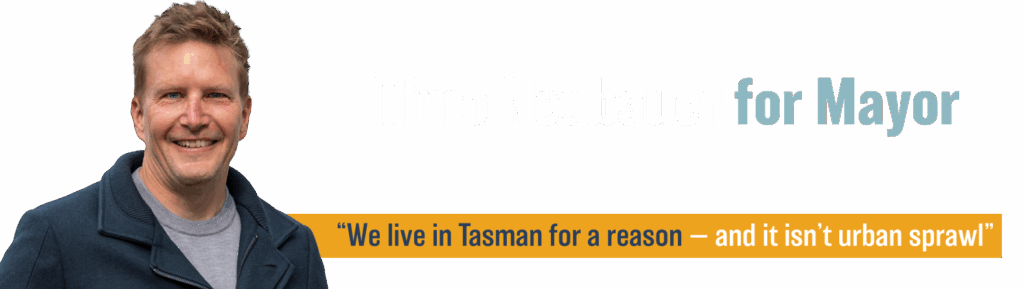
Timo Neubauer is a Hope-based urban designer and small business owner. He is a mayoral candidate for Tasman in this year’s local government elections.
This article responds to Nick Smith’s “The Nelson-Tasman case for a council merger”, Sunday Star Times, 25.05.2025