

Climate change and resilience policies
2. First policy
Prioritise adaptation planning – we need to be clear about risks and how we adapt in ways that are affordable, fair and future-focussed.
3. Second policy
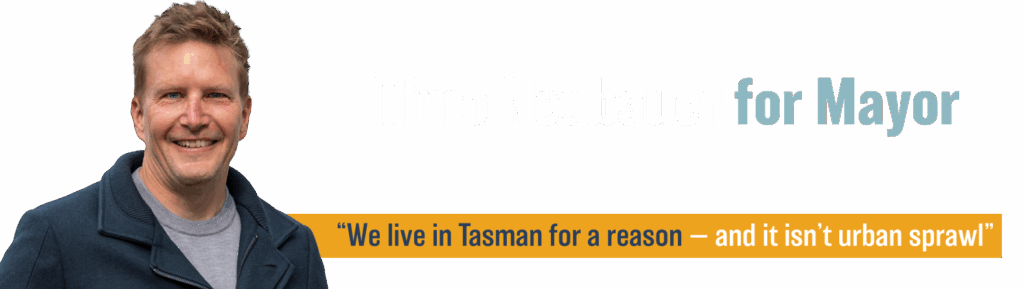
Stop the sprawl – shifting to a quality, compact growth model is the single most effective action TDC can take to cut community emissions.
4. Third policy
Review TDC’s role in clear-fell forestry, wetland rehabilitation and river management to help flatten future flood peaks.
Your environment and biodiversity policies
5. First policy
Stop the sprawl – direct growth to stronger towns and villages to protect natural landscapes and habitats from encroachment.
6. Second policy
Encourage wetland restoration – natural sponges and filters that boost biodiversity and give flood protection to downstream communities.
7. Third policy
Review TDC’s forestry practices – to lead by example, reinstate forests’ sponge function, biodiversity and improve flood protection.
Your freshwater policies
8. First policy
Daylight streams, add open spaces, rain gardens and street trees – to protect water quality and manage urban stormwater.
9. Second policy
Encourage wetland restoration – natural filters that improve water quality and provide vital, tangible flood protection.
10. Third policy
Protect the integrity of Te Waihōpūpū Springs and its aquifer from pollution – e.g. including from farming and mining impacts.
Your housing and planning policies
11. First policy
Launch an Urban Design Competition – a bold, visual way to guide growth and bring the community into the conversation.
12. Second policy
Develop Neighbourhood Plans – to allow quality urban housing in the right spots, cutting red tape and keeping growth sensible.
13. Third policy
Fix our rating and contributions policy – to align with infrastructure costs, discourage land-banking and incentivise efficient land use.
Your jobs and economy policies
14. First policy
Safeguard productive land and natural areas to strengthen local industries, businesses and tourism, that rely on them.
15. Second policy
Boost small businesses with markets, festivals and policies that showcase and celebrate our local products.
16. Third policy
Support small businesses to grow by fostering a Council service culture and easing regulatory barriers.
Your local democracy policies
17. First policy
Streamline decision-making: delegate routine matters to focus groups so Council can focus on strategy, finances, and key infrastructure.
18. Second policy
End public exclusion from Council meetings except for legally confidential or negotiation-sensitive items.
19. Third policy
Adopt a new, fair Code of Conduct that better balances the interests of all involved.
Your rates and revenue policies
20. First policy
Set a new benchmark for capital spending – all projects must deliver long-term financial benefit and solve multiple problems where possible.
21. Second policy
Review the development contributions policy to ensure, as far as legally possible, that new greenfield developments cover their real costs.
22. Third policy
Follow sound fiscal principles – fund operations via rates, finance capital responsibly, avoid needless asset sales and lower debt.
Your recreation and culture policies
23. First policy
Launch an urban greening taskforce to add trees, parks and embed water-sensitive design in towns and villages.
24. Second policy
Promote community markets and festivals to celebrate local producers and attract visitors.
25. Third policy
Update alcohol policy to support cafes and bars in activating streetscapes and celebrating local products.
Your transport policies
26. First policy
Stop the sprawl – low-density growth drives congestion. Grow stronger towns and villages with more transport options.
27. Second policy
Stop politicising transport: congestion requires expert land use, urban design and planning solutions – not politics.
28. Third policy
Ensure that transport investment – like the Hope bypass – actually delivers long-term traffic solutions and the best return on investment.
Your utilities and services policies
29. First policy
Ensure that new capital investments make our utilities networks more efficient – not less – improving affordability and rates for good.
30. Second policy
Make service fees fair – cover actual costs, not prop up rates. E.g. dog fees should match dog-related costs, not raise revenue.
31. Third policy
Upgrade and maintain existing infrastructure first, and streamline Council’s structure to save costs and improve efficiency.
Your candidate profile
32. Why are you running for election?
I’m running for Mayor of Tasman – not as a career politician, but as someone who believes we urgently need honesty, strategic thinking, and some basic business sense leading this Council. In the situation we’re in, that might matter more than polished spin or bureaucratic credentials.
33. Why will you make a good elected representative?
With a Master’s degree, a career in urban design, and experience running my own business, I bring the skills and vision to help build stronger, safer communities while revitalising our towns and villages.
34. First priority
Focus on using existing infrastructure efficiently and improving oversight to keep rates down.
35. Second priority
Drive intensification of existing urban areas – well-designed and attractive development is key.
36. Third priority
Implement reforms to make TDC more transparent, democratic and accountable to Tasman residents.